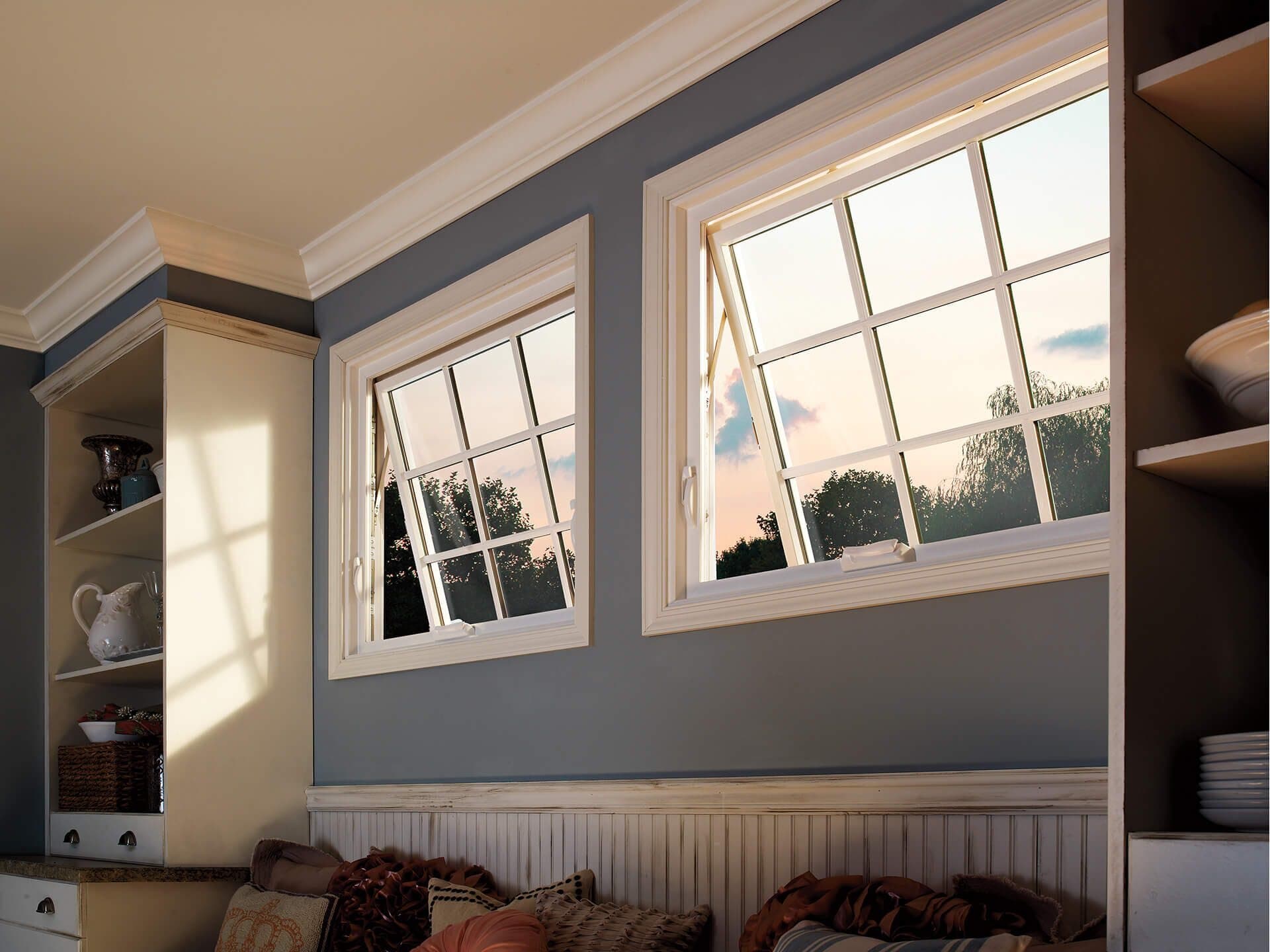
Turn a casement on its side and hinge it at the top and you have an awning window. The name is literal: opened, the sash slopes out over the opening the way a shop awning slopes over a doorway, and everything the style is good at follows from that one geometric fact.
How It Works
A scissor-arm operator raises the bottom edge of the sash outward while the top edge stays hinged to the frame. Like a casement, it locks by compression, pulling the sash up into its weatherstripping rather than sliding past it, so the seal is the tight kind. The mechanics are simple enough that awnings are among the least troublesome operating windows made.
Ventilation That Ignores the Forecast
The open sash is its own roof. Ordinary rain falls on the glass and sheds off the bottom edge, outside the opening, so an awning can sit cracked through a spring shower that would have you sprinting to close any other window in the house. In a climate that spends half the year threatening rain, that is not a small feature: it is the difference between a house that airs out in April and one that waits for June.
High on the Wall Is Home
Because the sash tilts out rather than up or sideways, an awning works in places a hung window cannot: the short strip of wall above a kitchen counter, a bathroom where privacy matters more than view, a basement half-window, the space under a big fixed pane. Set above eye level it brings in light and air while the room stays private, and the crank means height is never a reason it goes unopened.
Living With One
Keep the operator arm's pivots clean and occasionally oiled and an awning asks for little else. The habits are the casement's: close it fully before real wind, and let the interior-mounted screen do its work out of the weather. One honest limit: an awning high on a wall vents beautifully but cleans from a step stool, so on upper floors we usually pair it with glass you can reach.